High temperature silicone sealant Kömmerling Köditec 114
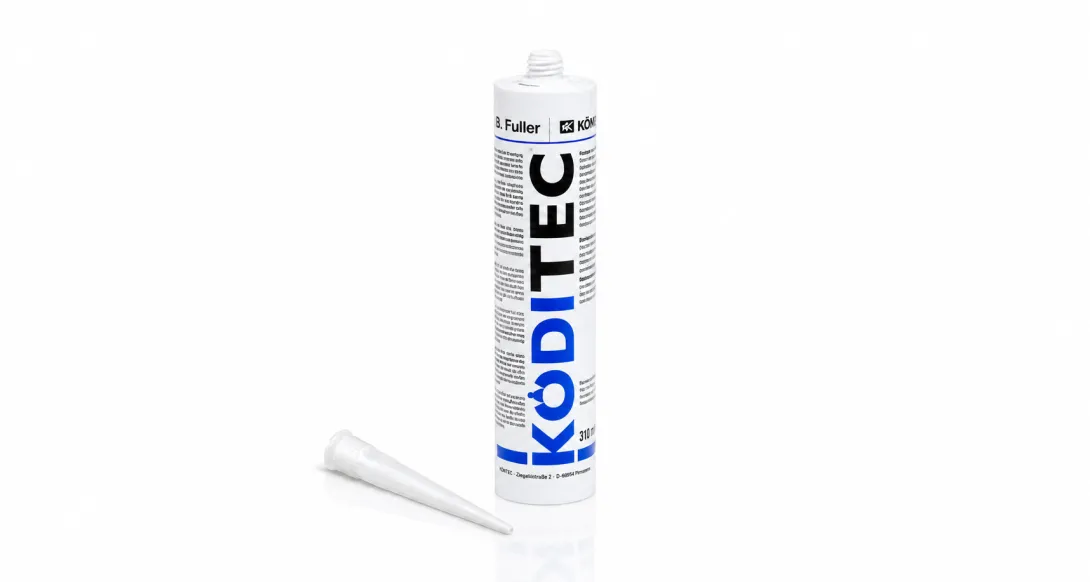
- 250 °C continuous service
- 350 °C peak for one hour
- Resists engine oil and coolant
- Bonds glass metal and enamel
Quote
Close
You request has been sent.
We promise to respond to you in detail within 24 hours.
In the meantime, feel free to browse our other products.
What is the Köditec 114 silicone sealant?
The Köditec 114 is a one-component silicone sealant from the Kömmerling range. It cures with atmospheric moisture and holds its mechanical properties from -40 °C to +250 °C in continuous service, with peaks tolerated at 350 °C for one hour.
What separates it from ordinary silicone sealants is not the temperature figure alone, it is the retention of mechanical strength when hot. A standard sealing silicone softens and creeps well below 250 °C, while the 114 keeps enough cohesion to form a flexible structural joint rather than a simple caulking bead.
Its second distinguishing property is its resistance to engine oils and coolants, where most construction silicones degrade on contact with hydrocarbons. That combination — heat, mechanical load and oil contact — defines where it belongs.
Its anthracite colour keeps it discreet on painted sheet metal and dark enamelled parts. Within the same range, the Ködisil N answers an entirely different need, that of fungicidal sanitary joints without MEKO.
Which industrial applications suit the Köditec 114?
The Köditec 114 belongs wherever an assembly must stay sealed and bonded through prolonged thermal exposure: cooking appliance manufacturing, thermal protection components and static engine sealing.
In home appliances, this is the manufacturer's reference application: bonding inner oven door glass, sealing oven doors and assembling parts that combine glass, metal and plastic on ovens, microwave ovens and irons. A silicone joint replaces a mechanical fixing that would transmit thermal expansion stress straight into the glass.
In mechanical engineering and engines, it provides static sealing on oil pans and valve covers, where heat is compounded by permanent oil contact. In heating and air conditioning and in metalwork, it is used to build thermal protection components.
What these cases share is the difference in thermal expansion between two dissimilar materials. A silicone absorbs that movement where a rigid adhesive would crack. For an assembly that never sees heat, our hybrid MS polymer sealants offer better adhesion and our polyurethane sealants higher mechanical strength.
How do you apply the Köditec 114 silicone sealant?
The governing factor is the substrate. The Köditec 114 adheres to aluminium, steel, glass and vitrified or enamelled surfaces. It is not suited to galvanised metals or non-ferrous metals — copper, brass, bronze — where adhesion is not guaranteed.
Surfaces must be clean, dry and degreased, which matters twice over on oven glass bonding where a single greasy residue is enough to ruin adhesion. Our cleaning and degreasing wipes suit that preparation.
Apply the bead continuously and without air pockets, then tool it before skin formation, which happens quickly. Because the product cures on ambient moisture, cure speed depends on humidity and on bead thickness: a thick joint hardens from the surface inwards, and loading it too early peels the bead before it has cured through.
Do not bring the part up to temperature before the cure is complete. Heating an oven on a joint that is still fresh traps the cure by-products and leaves bubbles in the bead.
What are the technical specifications of the Köditec 114?
The Köditec 114 withstands -40 °C to +250 °C continuously and 350 °C for 60 minutes, with a tensile strength of 2.6 MPa.
| Chemistry | One-component moisture curing silicone |
| Colour | Anthracite |
| Consistency | Non-slump thixotropic paste |
| Continuous service temperature | -40 °C to +250 °C |
| Peak temperature | 350 °C for 60 minutes |
| Tensile strength | 2.6 MPa |
| Chemical resistance | Excellent against engine oils and coolants |
| Suitable substrates | Aluminium steel glass vitrified and enamelled surfaces |
| Unsuitable substrates | Galvanised metals and non-ferrous metals |
| Packaging | 310 ml cartridge |
| Storage conditions | Between +5 °C and +30 °C in dry conditions |
The 2.6 MPa tensile strength is measured after full cure at ambient temperature and decreases when hot, as it does for any silicone elastomer. The figure quoted at 350 °C is a peak exposure limited to one hour and not a continuous rating: confusing the two is the most common mistake made with this type of product.
Sources: H.B. Fuller Engineering Adhesives Product Selection Guide 2026, H.B. Fuller General Industry application guide and Kömmerling documentation. Data verified on 25 November 2026.
Adezif in figures

+ 30 technical experts in industrial adhesives

1 internal laboratory to test and validate our solutions

+ 5,000 m2 of production and storage

+ 3,000 active customers trust us