Polyurethane adhesive for flexible impact resistant bonding
- Single and two-component PU adhesives
- Flexible bonding resistant to impact
- Wood plastics and composites
- Thick joints and gap filling
Quote
Close
You request has been sent.
We promise to respond to you in detail within 24 hours.
In the meantime, feel free to browse our other products.
What are the characteristics of a polyurethane adhesive?
A polyurethane adhesive cures through the reaction between a polyol and an isocyanate, and gives a flexible joint rather than a rigid one. That is its fundamental difference from an epoxy adhesive: where epoxy transmits loads through a hard joint, PU absorbs them by deforming.
This elasticity, in the range of 50 to 250 % elongation depending on the grade, gives three concrete advantages: good resistance to impact and vibration, the ability to absorb differential expansion between two materials with widely different coefficients, and the filling of gaps several millimetres wide without cracking.
Most grades can be sanded and painted once cured, which avoids a finishing operation. In return, a PU does not replace a rigid structural adhesive on bare metal under high static load: for that requirement, epoxy or two-component acrylic remain the right choices.
Examples of polyurethane bonding applications
- Bonding sandwich panels and partitions
- Assembling joinery and wood-based panels
- Bonding thermoplastic parts in plastics processing
- Bodywork and composite parts in repair
- Manufacturing blades and nacelles in wind power
- Signage and furniture exposed to temperature variation
What are the different types of polyurethane adhesive?
Three technologies share the same name, and they are not applied in the same way.
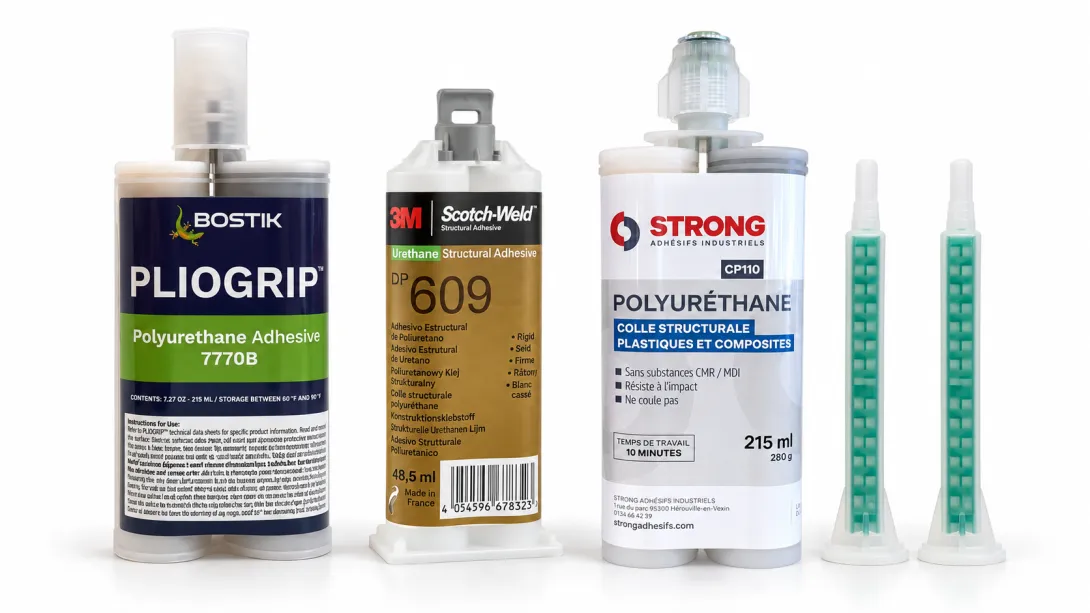
Two-component, chemically cured · resin and hardener metered automatically in the cartridge, mixed on extrusion, polymerisation at ambient temperature. This is the format of structural and repair adhesives, with open times from a few seconds to 45 minutes depending on the grade. Grades 3M DP609, DP610, 3532 B/A and Bostik Pliogrip 3540.
Single-component, moisture curing · ready to use, it cures with the moisture in the air, starting from the surface of the joint. Practical on site and over long joint lengths, slower through the thickness. It overlaps the polyurethane sealant family when sealing matters more than bonding.
PUR applied hot · reactive hot melt, extruded with a heated applicator then cross-linked by moisture. Initial grab in a few seconds, assembly without clamping. For hot melt glue sticks and hot glue applicators, see the dedicated pages.
Open time handling time and viscosity of a PU adhesive
Two durations not to be confused when choosing.
Open time is the period during which the adhesive stays spreadable and the parts repositionable: it dictates the size of the part that can be coated in one pass.
Handling time is the period before the assembly can be unclamped or handled, without the final performance being reached — that comes after 24 hours for most two-component PU adhesives. A grade with a short open time, in the region of 30 seconds, suits small repairs; a grade at 45 minutes is made for large panels.
On the rheology side, viscosities range from fluid formulations that penetrate by capillary action to thixotropic pastes that do not run and allow vertical bonding. A thixotropic adhesive is also the one that holds a thick joint without sagging.
How to apply a two-component polyurethane adhesive?
The two-component cartridge is used with an EPX applicator and a mixing nozzle: metering, mixing and extrusion happen in a single operation, which eliminates any error in proportion.
Purge the first few centimetres of bead until the colour is uniform before coating the part.
Lay a regular bead rather than a spread film, assemble before the end of the open time, then hold in position for the handling time.
The mixing nozzle is single use: once the adhesive has cured inside it, it is replaced and the cartridge is kept.
On large surfaces, some grades are applied with a pneumatic applicator for continuous output.
Which materials can be bonded with a polyurethane adhesive?
Polyurethane is first of all the adhesive for wood, plastics and composites. It covers rigid thermoplastics, polyester and epoxy thermoset composites, wood-based panels, glass and, depending on the grade, painted or coated metals without primer.
Two limits to know before ordering. Low surface energy plastics, polyethylene and polypropylene, require prior treatment or a dedicated chemistry. And on bare metal under high load, the rigidity of an epoxy or the strength of a methacrylate acrylic will give better results.
In every case, a clean, dry and degreased substrate governs adhesion: degreasing is not a precaution of principle but the first factor in joint strength.
Polyurethane adhesive and the European diisocyanate restriction
This is the regulatory point that concerns workshops directly. Since 24 August 2023, entry 74 of Annex XVII of the REACH regulation has required mandatory training before any industrial or professional use of a product containing more than 0.1 % free monomeric diisocyanates.
Polyurethane adhesives are first in line, and the training must be renewed every five years. A grade formulated below this 0.1 % threshold escapes the obligation: this is the case of Bostik Pliogrip 3540, which contains no free aromatic monomeric diisocyanate above the threshold.
For a workshop that has not yet had its operators trained, this criterion often weighs as much as mechanical performance. Check section 2 of the safety data sheet of the selected grade for its exact content.
Some advice for choosing your polyurethane adhesive
- Start from the size of the part to choose the open time, not the other way round: too short an open time on a large panel ends in a failed bond
- Prefer a grade below 0.1 % monomeric diisocyanate if operators are not yet trained
- Choose a thixotropic paste as soon as bonding is vertical or the joint exceeds one millimetre
- Check compatibility with the planned finish: not every grade withstands powder coating
- For a metal-to-metal assembly under load, compare with an epoxy or an acrylic before deciding
- Order mixing nozzles in quantity: they are a consumable, not an accessory
Examples of polyurethane adhesive grades:
| Grade | Type | Positioning |
|---|---|---|
| Bostik Pliogrip 3540 | Two-component 1/1 | Below 0.1 % diisocyanate, thermoplastics and painted metals, sandable and paintable |
| 3M DP609 | Two-component EPX | Beige, flexible, fast setting, controlled sag |
| 3M DP610 | Two-component EPX | Clear, flexible, non-yellowing |
| 3M 3532 B/A | Two-component | Viscous, structural, resistance to impact and vibration |
| 3M DP600 SL | Two-component self-levelling | Concrete repair, cracks and anchoring |
| 3M 5005 | Single-component cartridge | PU adhesive sealant for wood |
Adezif in figures

+ 30 technical experts in industrial adhesives

1 internal laboratory to test and validate our solutions

+ 5,000 m2 of production and storage

+ 3,000 active customers trust us
Customers who viewed this page also viewed
-
Quelles sont les caractéristiques d'une colle epoxy ? Une colle époxy appartient à la famille des adhésifs thermodurcissables, c’est-à-dire qu’elle...
-
Qu'est ce qu'un ruban adhésif double-face VHB ? Les adhésifs VHB (Very High Bond) développés par la société 3M permettent un assemblage définitif e...
-
Descriptif de la colle cyanoacrylate liquide ou en gel La colle cyanoacrylate (ou colle glue) est une colle monocomposant à prise instantanée, part...
-
Qu'est ce qu'une colle thermofusible en batonnet ? La colle thermofusible, ou colle hot melt, est une solution pratique, simple, performante et rap...