


Solvent-free water-based adhesive for large surface bonding
- Water-based dispersion adhesives
- No solvent and no VOC
- Large surfaces and lamination
- Long open times
Quote
Close
You request has been sent.
We promise to respond to you in detail within 24 hours.
What is a water-based adhesive?
A water-based adhesive is an adhesive whose polymer is dispersed in water instead of being dissolved in a solvent. Water is only a carrier: the bond forms once it has left the joint, by evaporation into the air and by absorption into the substrate.
It also goes by the names waterborne adhesive, water-borne dispersion or dispersion adhesive. These all describe the same technology, which then varies with the polymer dispersed, from natural latex to polyurethane dispersion.
The fundamental difference from a solvent-based adhesive lies in the carrier, and it has three consequences. There is no solvent to drive off, therefore no volatile organic compound and no flammability, which eases workstation ventilation and storage. Open times are longer, from a few minutes to an hour, which allows large parts to be coated in a single pass. In return, drying depends on the substrate and on ambient conditions, where a solvent-based adhesive dries much the same way everywhere. That is the first criterion to examine, well before mechanical performance. These adhesives complement the other families of glues for industry rather than replacing them.
What are the applications of a water-based adhesive?
Water-based technology is the reference for bonding large surfaces. It is applied by roller or spray, metered in grams per square metre and supplied in pails of 5 to 20 kg, which makes it a lamination-station product rather than a spot-bonding one.
Lamination of decorative panels and sandwich panels
Assembly of foams for bedding and seating
Bonding textiles, leather and felt onto rigid substrates
Interior fit-out, furniture and vehicle conversion
Bonding wood and wood-based panels in industrial joinery
Lining plasterboard and insulation panels
Where surface bonding has to be done upstream rather than at the customer's station, Adezif carries it out in its own custom lamination workshop.
What are the different types of water-based adhesive?
The name describes a carrier, not a chemistry. Five polymer families are dispersed in water, and they do not behave in the same way.
Acrylic dispersion · good ageing and UV resistance, used for laminating flexible materials and panels. It shares its chemistry with the acrylic adhesive family, with an entirely different application method.
Polyurethane dispersion · joint flexibility and resistance to differential expansion, for assemblies that move. See also polyurethane adhesives in cartridge for flexible structural bonding.
Polychloroprene latex · this is the contact adhesive in its water-based form, with the high initial grab that characterises the family. It also belongs to the neoprene adhesive family, whose page details the double-coating principle.
Natural latex · a clear and elastic film, tolerant to moisture, for flexible assemblies that must stay discreet.
EVA and vinyl dispersion · the classic chemistry for bonding wood and porous materials, economical and simple to apply.
What open time and coverage for a water-based adhesive?
Open times run from 3 minutes to one hour and coverage from 80 to 350 g/m² depending on the grade. Together with viscosity, these are the three parameters that separate two products of the same chemistry — and the price per kilo is not one of them.
Open time is the period during which the adhesive stays spreadable and the parts repositionable. It dictates the surface that can be coated in one pass: too short an open time on a large panel ends in a failed bond. Three to five minutes suits a fast contact grab, one hour suits large panel assembly.
Coverage depends on substrate porosity, and the gap between the two extremes is a factor of four. It drives the cost per square metre far more than the price of the pail. A highly absorbent substrate drinks the first pass and often calls for a double coat.
Viscosity, from 450 to 20,000 mPa·s depending on the grade, governs the application method: fluid formulations go through a spray gun, thick pastes are spread with a roller or notched trowel without running on a vertical substrate.
How to apply a water-based adhesive?
One rule governs application: the water must have left the joint before assembly, otherwise the bond does not form. The visual cue is the same as for a conventional contact adhesive — the film loses its milky appearance and turns translucent.
Work on a clean, dry and degreased substrate — see surface preparation before bonding
Apply by roller, notched trowel or spray gun depending on viscosity, in an even coat
Double the coat on highly porous substrates, which absorb the first pass
Respect the flash-off time given on the technical data sheet before assembling
Roll or press to bring the two surfaces into intimate contact
Clean tools with water while the adhesive is fresh; it becomes insoluble once dry
Two workshop conditions matter more than with solvent-based products. A low temperature or high humidity lengthens drying appreciably. And the product does not tolerate frost in storage: a frozen pail is lost, which is worth checking on the data sheet before storing in an unheated area.
Which materials can be bonded with a water-based adhesive?
The deciding criterion is not the nature of the material but its porosity. The water has to go somewhere: at least one of the two substrates must absorb it, or the assembly must stay open long enough for it to evaporate.
Absorbent substrates are the natural ground of the technology: wood and wood-based panels, particleboard and plywood, card and paper, textiles, leather, felt, cork, open-cell foams and plasterboard.
Non-porous substrates — sheet metal, laminate, polystyrene, plastic films — are bonded by pairing them with an absorbent one, the porous face venting the water for both. Some polychloroprene latex formulations will nevertheless take two non-porous faces.
Two limits to know. Low surface energy plastics, polyethylene and polypropylene, require prior treatment whatever the chemistry — see surface energy and bonding. And on a metal-to-metal assembly under load, water-based is not the right tool: an epoxy adhesive or a two-component acrylic will answer better.
Does a water-based adhesive emit VOCs?
A water-based adhesive contains no organic solvent, so it releases no volatile organic compound as it dries: what evaporates is water. This is the argument that most often decides the switch, and it is regulatory as much as technical — removing the solvent also removes the product's flammability, which eases workstation ventilation, storage and operator protective equipment.
This is also why water-based technology is presented as the environmentally friendly route by adhesive manufacturers: no solvent means no emission at the workstation and a lighter footprint across the product's life.
On projects and markets that require it, grades may carry emission classifications. Emicode EC1 identifies very low emission products for interior use, and Giscodes indicate the handling risk level. Not every water-based adhesive holds one: it is a grade-specific characteristic, to be checked on the data sheet.
For a workshop looking to move away from solvent without changing its workstation, two other routes exist depending on the application: hot melt adhesive, also solvent-free, and UV curing adhesive for clear assemblies.
How to choose a water-based adhesive?
Choose in this order: first the porosity of the substrates, which tells you whether the technology applies at all, then the open time based on part size, and only then performance. Seven points to check before ordering.
Start with the porosity of both substrates: it decides whether the technology suits, before any performance consideration
Choose the open time from the size of the part to be coated, never the other way round
Think in cost per square metre rather than per kilo; coverage varies by a factor of four
Check the viscosity against the application equipment available in the workshop
Ask for the emission classification if the finished product is destined for an occupied space
Plan frost-free storage, the most frequent cause of loss in this family
Run a trial on the real substrate pair before fixing the grade, particularly if one of the two is non-porous
If you are unsure about a material pair, our laboratory runs the adhesion tests: tell us about your application.
Manufacturer values given for guidance and not contractually binding. Sources consulted on 5 November 2026: H.B. Fuller product documentation and the data sheets of the grades listed.
| Grade | Chemistry | Positioning |
|---|---|---|
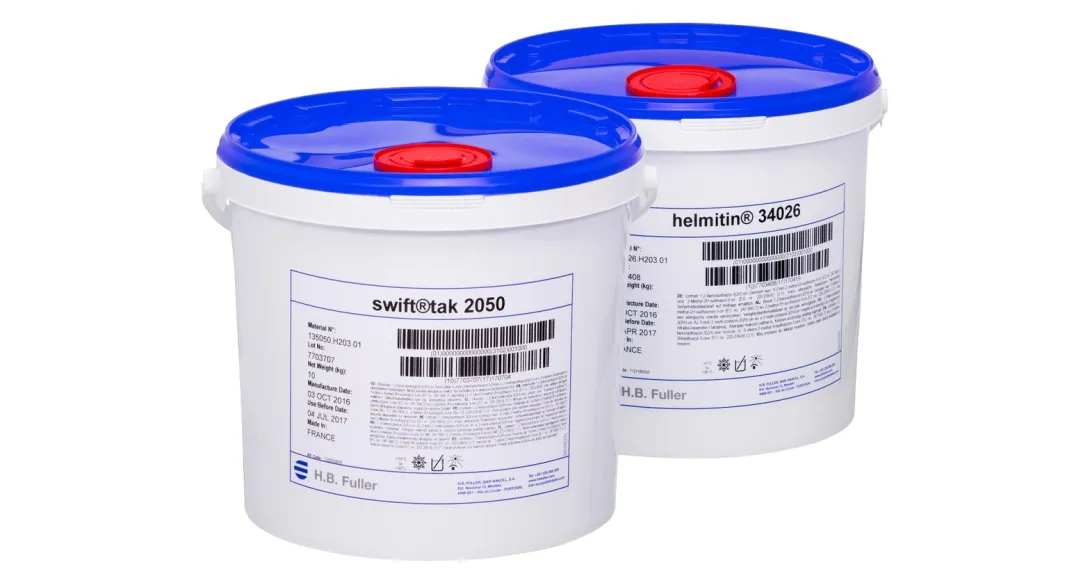
| H.B. Fuller Swift tak 2050 | Dispersion | High surface tack, heat and plasticiser resistance |
| H.B. Fuller Köracoll WB 20 | Dispersion | Low emission, Emicode EC1, open time 10 to 20 minutes |
| H.B. Fuller TEC 540 | Water-based | High initial grab, panels and construction components |
| H.B. Fuller Helmitin 38151 | Polychloroprene latex | Porous and non-porous substrates, multi-material assemblies |
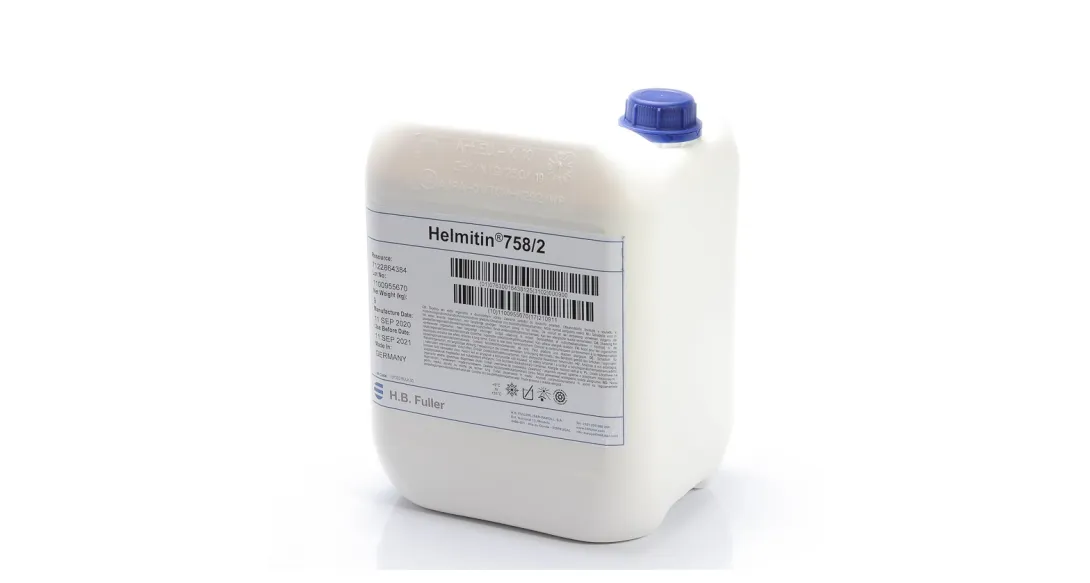
| H.B. Fuller Helmitin 758/2 | Natural latex | Clear and elastic film, moisture resistance |
| H.B. Fuller Helmitin 34026 | EVA dispersion | Foams, textiles and flexible assemblies |
| H.B. Fuller Köracoll 2027 | Acrylic dispersion | Laminating flexible materials and panels |
| H.B. Fuller Köracoll 3050 | Polyurethane dispersion | Lamination with joint flexibility |
Manufacturer values given for guidance and not contractually binding. Sources consulted on 5 November 2026: H.B. Fuller product documentation and the data sheets of the grades listed.
Adezif in figures

+ 30 technical experts in industrial adhesives

1 internal laboratory to test and validate our solutions

+ 5,000 m2 of production and storage

+ 3,000 active customers trust us


