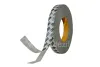
Electrically conductive double sided tape 3M 9723
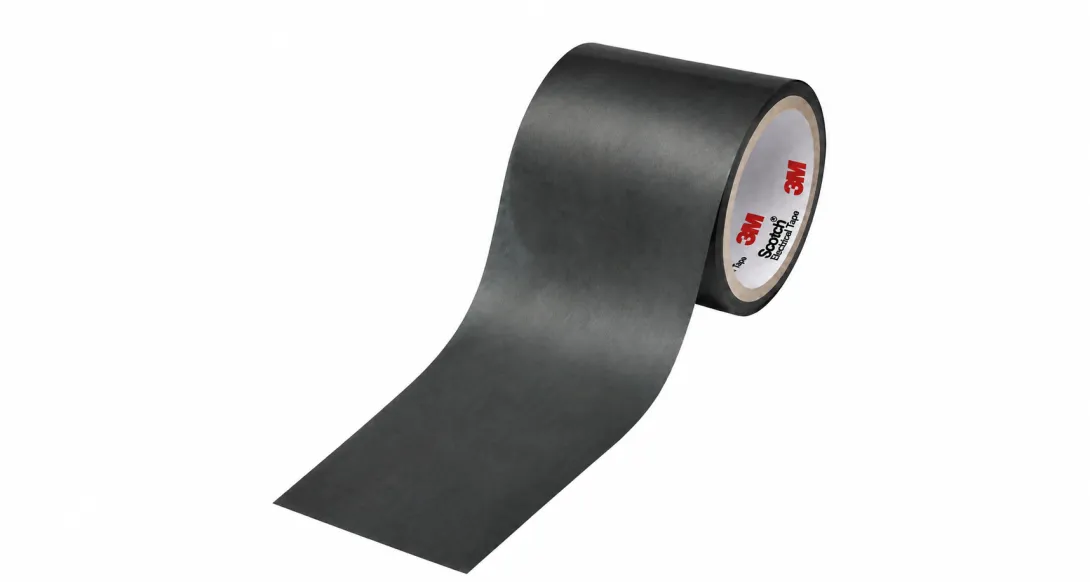
- Bonding and grounding in one step
- Conduction on all three axes
- Shielding from 40 to 60 dB
- Only 60 µm thick
Quote
Close
You request has been sent.
We promise to respond to you in detail within 24 hours.
In the meantime, feel free to browse our other products.
What is the 3M 9723 electrically conductive double sided tape?
The 3M 9723 is an electrically conductive double sided tape built on a nickel-copper metallised non-woven carrier coated on both faces with a conductive acrylic adhesive. It bonds two parts and establishes their electrical continuity in a single operation, with no screws, no grounding braid and no solder joint.
What sets it apart is conduction on all three axes X Y and Z. The adhesive conducts through its own thickness, so current passes from one part to the other straight through the tape, while the non-woven carrier conducts in plane, which carries the ground path along the length of the assembly. A plain copper foil tape with non-conductive adhesive does neither, and a standard adhesive transfer tape stays dielectric.
At 60 µm total thickness, it fits where a conductive gasket or a metallised foam cannot go: under a cover, between two enclosure panels, along a ribbon cable shield. Its shielding effectiveness of 40 to 60 dB suits assemblies that must meet electromagnetic compatibility requirements. Because the carrier is a non-woven, it conforms to slightly uneven surfaces instead of creasing and marking the way a metal foil does — the same behaviour found across our other double sided non-woven tapes, applied here to an electrical function.
Both faces are metallic grey and each is protected by a transparent PET liner, so you can lay the first face down, position the part, then peel the second liner at the last moment.
Which industrial applications use the 3M 9723 conductive tape?
The 3M 9723 belongs wherever a mechanical joint also has to be an electrical contact: EMI shielding of electronic enclosures, grounding between two chassis elements, fastening flexible shields onto ribbon cables and harnesses, and joining conductive films or metallised fabrics.
In consumer electronics and telecoms, it ties metallised covers to boards and chassis to contain radiated emissions. In automotive and rail, it maintains the ground path of lighting modules, integrated antennas and shielded harnesses, where a bolted connection would be too heavy or impossible to fit. In appliances and industrial equipment, it handles electrostatic discharge dissipation on metallised plastic parts.
It also answers prototyping and short-run needs: fixing an EMC failure late in validation, closing a radiated leak on an enclosure that is already tooled, or creating a ground connection nobody planned for, without modifying the part. In those cases a taped solution avoids a design iteration altogether.
For assemblies with no electrical function, our other double sided non-woven tapes deliver higher bond strength at lower cost. And if what you need is electrical insulation rather than conduction, this product is its exact opposite: the 9723 conducts, it does not insulate.
The tape comes in 500 mm × 100 m rolls, a format from which Adezif performs custom die cutting into strips or shaped parts matching your enclosure geometry.
How do you apply the 3M 9723 conductive tape correctly?
One rule governs everything else: conduction depends on applied pressure. A conductive adhesive only makes contact once its conductive particles are compressed against the substrate. Hand pressure alone gives you a decent bond and a poor electrical path.
Apply the tape under 5 to 15 psi for 2 to 5 seconds, at a surface temperature between 21 and 38 °C. Heating to 38 to 60 °C improves wet-out on difficult surfaces but is not mandatory. Never apply below 10 °C: the acrylic adhesive stops wetting the surface and the electrical contact never forms.
Surfaces must be clean, dry and degreased. Clean with isopropyl alcohol or heptane using our cleaning and degreasing wipes, then let the solvent flash off completely before laying the tape. On oxidised or passivated metal, remove the oxide layer first: it is an insulator and it will ruin your resistance reading no matter how good the tape is.
Lay the first face, position the part, then peel the second PET liner and roll the joint down. Verify contact resistance with an ohmmeter rather than trusting appearance — it is the only way to validate a ground path. If the reading is high, the cause is almost always insufficient pressure or poor surface preparation, not the tape.
What are the technical specifications of the 3M 9723 conductive tape?
The 3M 9723 delivers 0.3 Ω on the XY axis and 0.15 Ω on the Z axis, at a total thickness of 60 µm, with 1500 gf/inch adhesion to stainless steel. It withstands 85 °C continuously and 121 °C as a peak.
| Carrier | Nickel-copper metallised conductive non-woven |
| Adhesive | Conductive acrylic on both faces |
| Total thickness | 60 µm (ASTM D1000) |
| Colour | Metallic grey on both faces |
| Liner | Transparent PET on both faces |
| Adhesion to stainless steel | 1500 gf/inch (ASTM D1000) |
| XY axis resistance | 0.3 Ω on each face (3M ETM-7) |
| Z axis resistance | 0.15 Ω (3M ETM-12) |
| Shielding effectiveness | 40 to 60 dB |
| Continuous temperature | 85 °C |
| Peak temperature | 121 °C |
| Storage conditions | Away from moisture and frost |
| Standard format | 500 mm × 100 m |
Resistance values are measured to 3M internal methods ETM-7 and ETM-12 rather than a public standard: they compare reliably between 3M tapes, but not directly against figures published by another manufacturer. Shielding effectiveness of 40 to 60 dB depends on frequency and on assembly geometry, so it does not transfer as-is to your own application.
Source: 3M technical datasheet, Technical Data August 2020, reference 60-5005-0232-7. Data verified on 23 November 2026.
Adezif in figures

+ 30 technical experts in industrial adhesives

1 internal laboratory to test and validate our solutions

+ 5,000 m2 of production and storage

+ 3,000 active customers trust us